When India Sleeps, You Grade: A Self-Assessment System for CBSE Students Studying in the US
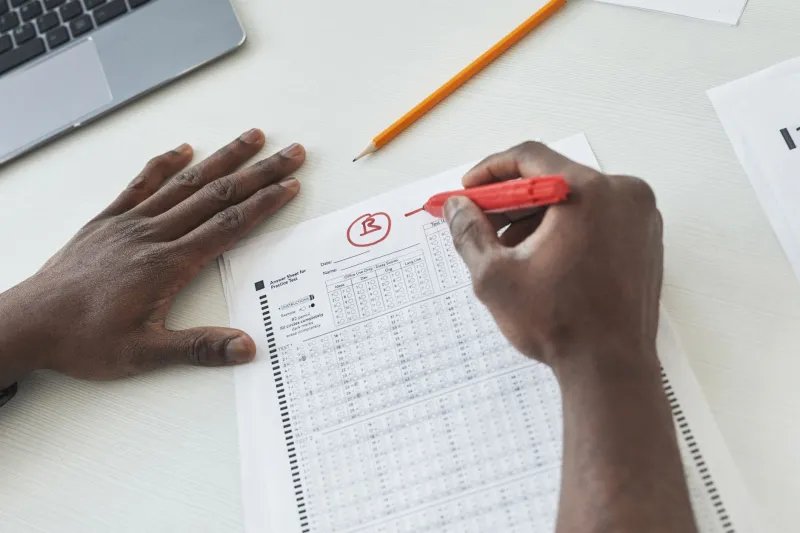
Every CBSE student in the United States eventually runs into the same wall. You finish a full-length sample paper at 9 p.m. Eastern time, ready to find out where you stand — and your tutor in Bengaluru is twelve hours away from reading a single line of it. By the time feedback arrives, the paper has gone cold in your mind, and the momentum you built solving it has drained away.
The good news is that the CBSE system hands students everything needed to close that loop independently. The official marking scheme is not a vague answer key; it is a step-by-step breakdown of exactly where marks are awarded. Once a family learns to use it properly, the time zone gap stops being an obstacle and becomes a reason to build sharper study habits.
Why the Marking Scheme Is the Most Underrated Study Tool
Most students treat sample papers as a test and the marking scheme as an answer sheet. That framing wastes the resource. The CBSE marking scheme shows how examiners distribute credit across steps, definitions, diagrams, and working. A student who studies it before attempting a paper learns what a full-mark answer actually looks like — not just what the correct answer is.
Read the scheme first for one section, attempt those questions, then compare. This reverses the usual order and turns self-assessment into a teaching tool rather than a verdict.
A Parent-Friendly Self-Grading Rubric
Many American parents supporting a CBSE student did not sit CBSE boards themselves. That is fine. Grading does not require subject mastery — it requires process. Here is a rubric any parent can apply alongside their child:
- Checklist matching, not judgment. The parent holds the marking scheme; the student's answer is checked line by line against it. If a step appears in the scheme, it earns the marks printed next to it.
- Half-mark honesty. CBSE awards partial credit generously. Train the family to award step marks exactly as printed, no more, no less.
- The two-column error log. One column records content errors (wrong formula, missing fact); the other records presentation errors (skipped steps, unlabeled diagrams). Presentation errors are the cheapest to fix and often worth the most marks.
- A timed re-attempt. Any question that lost marks gets re-solved, cold, within 48 hours.
Fifteen minutes of structured grading this way typically reveals more than an hour of unstructured tutoring.
Building the Asynchronous Feedback Loop
Self-assessment works best when it is paired with a slow-burn feedback channel. Families in the US can set up a simple rotation:
- Daily: the student grades their own work against the scheme and flags anything they cannot resolve.
- Weekly: flagged questions go into a shared document — Google Docs works well — sent to a relative in India, a weekend tutor, or an online CBSE platform.
- Bi-weekly: a 20-minute call, scheduled on the US weekend morning (which is India's evening), works through the flagged list only.
Because the call is short and targeted, it survives schedule conflicts on both sides of the globe. The student arrives with specific questions instead of paying for a tutor to watch them solve problems.
Turning the Gap Into an Advantage
There is a hidden benefit to grading your own work: you internalize the examiner's logic. Students who routinely mark themselves against the scheme develop an instinct for how much to write, when to draw a diagram, and which steps must be shown. On exam day, that instinct is worth more than any last-minute revision.
The nine-hour gap does not have to mean nine hours of waiting. With the official marking scheme in hand and a disciplined weekly loop, a student in Chicago or Atlanta can run a full CBSE practice cycle — attempt, grade, log, re-solve — before India even wakes up.