Reading the Verb First: A Parent's Guide to CBSE Command Words and the Marks They Hide

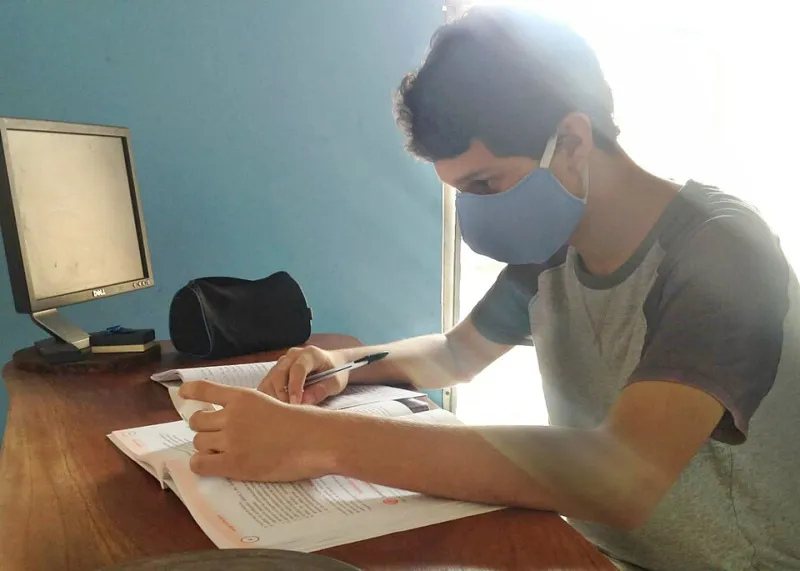
Photo: Becker1999, CC BY 2.0, via Wikimedia Commons
In many American classrooms, a prompt that begins with "explain" and one that begins with "evaluate" invite roughly the same paragraph. In a CBSE answer script, those two verbs sit at opposite ends of the marking scheme. A student can write four accurate sentences about photosynthesis and still lose marks, because the paper asked for a judgment and the child delivered a description.
Command words are the grammar of CBSE assessment. They tell the examiner what to look for, and they tell the student how much to write, in what shape, and with what kind of evidence. Teaching a child to read the verb before reading the question is one of the least expensive improvements available to any family preparing for Indian board examinations.
Why the Verb Comes First
CBSE marking schemes are constructed from the command word outward. Each question carries a mark value, and the scheme distributes those marks across specific moves: a statement, an explanation, an example, a reasoned conclusion. When the verb is "state", one clear sentence may be sufficient. When the verb is "justify", the sentence alone is worth almost nothing, because the marks live in the reasoning that follows it.
Two consequences follow. First, length is not a proxy for quality; writing far more than the verb demands can consume minutes a later question needed. Second, the verb determines the architecture of the answer: bullet points for "list", continuous prose for "discuss", a claim-plus-evidence structure for "justify".
The Verbs, Decoded
State, define, name, list. Recall only. One line, no elaboration, no example unless the question asks for one. A student who writes a paragraph here is not wrong, merely wasteful.
Describe. Say what happens, in order, with relevant detail. No reasoning is required. Think of it as a labelled diagram rendered in words.
Explain. Say what happens and why. The word "because" should appear at least once. Two or three sentences of cause and effect are usually expected.
Elucidate. The verb that unsettles students schooled abroad. It means explain with illustration: a short explanation followed by a concrete example, a diagram reference, or an applied instance. Explanation alone earns partial credit; the illustration completes it.
Justify. Make a claim, then defend it with evidence, data, or a principle from the textbook. "It is beneficial" is not a justification. "It is beneficial because it reduces fuel dependence while leaving cooking times largely unchanged, as the NCERT example demonstrates" is.
Evaluate, assess, critically examine. Weigh both sides, then commit to a conclusion. The conclusion is not optional. An answer that lists advantages and disadvantages and simply stops has done the "compare" job, not the "evaluate" job.
Compare, distinguish, differentiate. Usually a two-column table. Points must be matched pair by pair; a paragraph of facts about one item followed by a paragraph about the other loses marks for pairing.
Discuss. The broadest of the set. Present the main positions, support each with evidence, and close with a balanced view. Expect three or four distinct points.
Weak Versus Examiner-Friendly
Consider a Class 10 Science question worth three marks: Justify the use of solar cookers in rural households.
Weak: "Solar cookers are good for rural areas. They do not need electricity. They are cheap." Three true statements, no reasoning, typically one mark.
Examiner-friendly: "Solar cookers suit rural households because they require neither electricity nor fuel, both of which are often unreliable or costly in these areas; they also reduce indoor smoke, lowering respiratory risk. Their main limitation is dependence on direct sunlight, so they work best where cooking happens during daylight hours. On balance, the fuel savings and health benefits outweigh the scheduling constraint." Claim, evidence, limitation, verdict.
Now a Literature question: Elucidate the significance of the letter in the story.
Weak: "The letter is very important because it changes everything in the story." Accurate but unsupported.
Examiner-friendly: "The letter functions as the story's turning point: it supplies the information the protagonist has lacked, and it arrives exactly when her hope is lowest. For instance, when she reads it in the final paragraph, the narrative's tone shifts from resignation to resolve, confirming the author's concern with delayed justice." Explanation plus textual instance.
A Ten-Minute Kitchen-Table Drill
Copy eight short prompts onto a single sheet, each using a different command word from the list above, on a topic your child already knows well. Ask for one-sentence answers only. The constraint forces attention onto the verb rather than the content. Then read each aloud and ask a single question: did the answer do what the verb asked? Twice a week is enough to make the habit automatic.
A second pass works well with a highlighter. Hand over three past-paper questions and ask only that the command words be circled and translated into a plan — elucidate = explain plus example, evaluate = both sides plus verdict — before any writing begins.
Small Habit, Measurable Return
Command words do not add knowledge. They determine whether knowledge reaches the examiner in a form that earns credit. For students transitioning from American schooling, where assessment style shifts from teacher to teacher, the CBSE verb list is unusually stable: the same words, the same expectations, paper after paper. Learning that list is the closest thing to a guaranteed return in exam preparation.