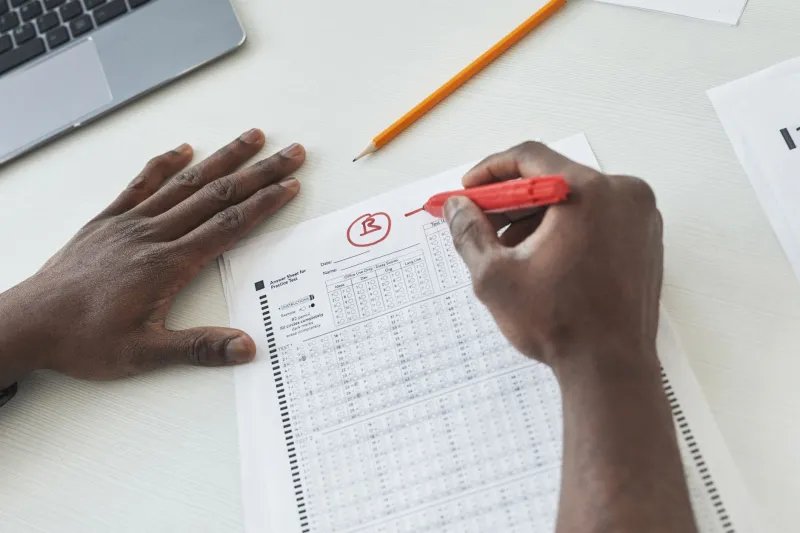
Every Line Counts: Why CBSE Examiners Reward the Attempt, Not Just the Answer
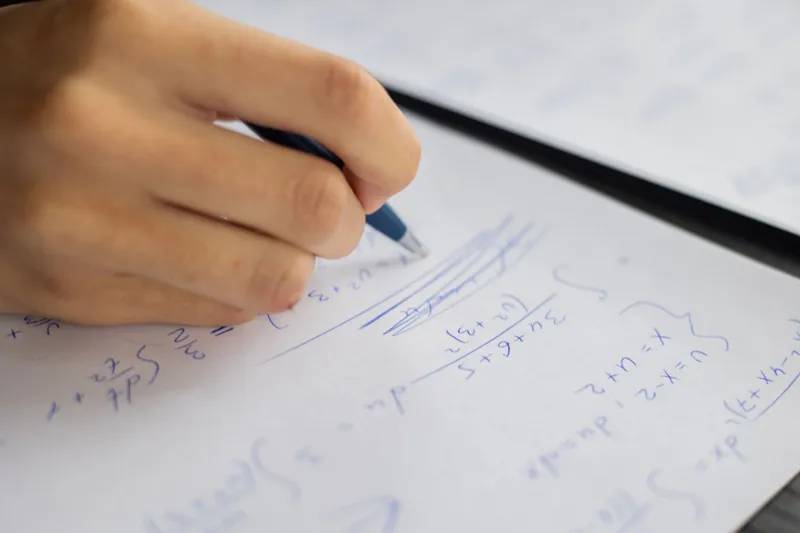
For families raising CBSE students in the United States, one of the most misunderstood features of Indian board exams is also one of the most forgiving: step-marking. American parents are used to the all-or-nothing logic of bubble sheets and auto-graded platforms — a wrong final answer earns a zero, no matter how sound the reasoning. CBSE examiners operate on an entirely different principle. They are instructed to award marks for every correct stage of a solution, which means a student who freezes halfway through a physics numerical can still walk away with most of the credit.
What Step-Marking Actually Is
CBSE's marking schemes — published after every board cycle — break each question into discrete scoring components. A six-mark mathematics problem might allocate one mark for the correct formula, one for proper substitution, two for intermediate simplification, and two for the final answer with correct units. The examiner's job is to tick each stage independently. If the final line is wrong but everything before it is right, the student typically earns four of six marks.
This is fundamentally different from the multiple-choice culture of the SAT or AP exams, where partial reasoning is invisible to the grader. On a CBSE paper, the work itself is the product.
A Worked Example
Consider a typical Class 10 question: A ball is thrown upward at 20 m/s. Find the maximum height.
A student who writes the correct kinematic equation (v² = u² − 2as), correctly substitutes the values, but then makes an arithmetic slip and reports 25 m instead of 20 m has demonstrated three of the four scoring components. Under a typical scheme, that student earns three of four marks. The error cost one mark — not the whole question.
Contrast that with an American-style test where the same slip yields zero. Teaching your child this distinction changes how they respond to being stuck. Instead of abandoning a problem, they write the formula, define the variables, and set up the substitution — banking marks while they think.
The Strategy Behind the System
Step-marking rewards a specific set of habits:
- Write the formula before touching numbers. This alone often earns a mark.
- Label every variable and unit. Examiners scan for correct notation.
- Never leave a question blank. An attempted derivation with a wrong conclusion frequently outscores an empty page.
- Show intermediate steps even when confident. A mental shortcut that goes wrong leaves nothing to award.
Students trained on American grading often strip their working to save time. On a CBSE paper, that thriftiness is expensive.
A Practice Drill Parents Can Run
You do not need to know calculus to supervise this drill — only a timer and patience.
- Choose three past-paper questions from the CBSE sample papers available on the official portal.
- Have your child solve them with full working, narrating each step aloud as if teaching you.
- Introduce one deliberate error — swap a sign, drop a zero — and let them re-solve while you check only the structure: formula written, values substituted, units stated.
- Score it like an examiner. Download the official marking scheme and award marks stage by stage together.
Fifteen minutes, three times a week, builds the reflex that matters most: writing something down even when uncertain.
The Bigger Lesson
Step-marking teaches something American test culture often obscures — that process has value. Students who internalize this approach to CBSE papers frequently find their confidence improves across subjects, because they stop treating every stumble as total failure. For a child juggling an American school day with CBSE preparation, that resilience is worth as much as any mark on the board.
The examiners in Delhi will never meet your child. But their marking scheme has already told you exactly what they want to see. Make sure your child shows it to them — one step at a time.