Where the Marks Really Live: Teaching Calculator-Schooled Kids to Show Their CBSE Math Working
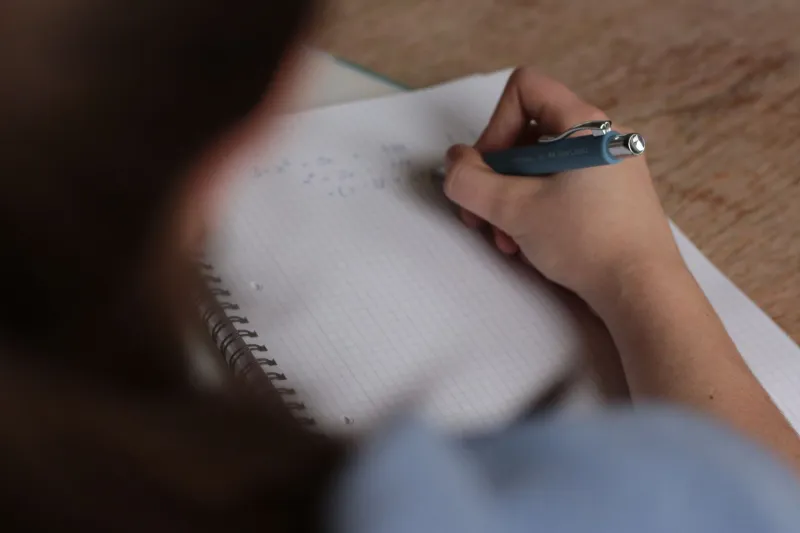
A student who knows the math can still lose the marks
Ask a typical American middle or high schooler to solve a quadratic equation, and you will often watch a familiar sequence: a quick mental calculation, a glance at the calculator, a final answer written neatly at the bottom of the page. The work in between? Usually missing.
In most US classrooms, that is acceptable. Homework platforms grade the answer box. Standardized tests reward speed. The calculator is a constant companion from elementary school onward.
The CBSE mathematics paper operates on entirely different assumptions. Examiners in Delhi are not hunting for answers — they are tracing a student's reasoning, line by line. Marks are distributed across the solution itself: for the formula written out, the substitution shown, the intermediate steps carried forward correctly. A correct final answer with no supporting work can earn a fraction of the available credit. A well-organized solution with one arithmetic slip can still collect most of the marks.
For families raising CBSE students in the United States — children who spend their days in American schools and their evenings on the Indian syllabus — this is the single most expensive gap to discover in March, weeks before the exam.
Why the step-by-step habit never develops in US classrooms
This is not a criticism of American teaching. It is a structural difference.
US math instruction, shaped by tools like TI-84 calculators, Desmos, and auto-graded online platforms, naturally emphasizes results. Students learn to set up a problem, let the tool compute, and move on. Written working, where it is required at all, is often optional or lightly weighted.
CBSE marking schemes run the opposite direction. A typical board question worth three or four points will carry designated marks for:
- Stating the relevant formula or theorem
- Correctly substituting the given values
- Carrying out each algebraic or geometric operation in visible sequence
- Stating the final answer with proper units
An examiner reading hundreds of papers under time pressure is instructed to award these component marks wherever they appear. Steps are not decoration — they are the currency.
Students schooled in the American system frequently write solutions the way they would on a whiteboard: compressed, intuitive, answer-first. The examiner sees an unmarked minefield and awards accordingly.
Before and after: the same problem, two very different scores
Consider a standard board-style question: Solve for x: 2x² − 5x − 3 = 0.
The American-habit version: the student factors mentally, writes "x = 3 or x = −1/2," and stops. If the factoring is correct, some credit may arrive — but there is no formula cited, no factorization displayed, no verification. On a three-mark question, this solution typically earns one mark at best.
The CBSE-disciplined version:
- Writes the equation and identifies the method (factorization).
- Splits the middle term: 2x² − 6x + x − 3 = 0.
- Groups: 2x(x − 3) + 1(x − 3) = 0.
- Factors: (2x + 1)(x − 3) = 0.
- States both solutions with a brief justification.
Same student. Same mathematical ability. The second version collects every available mark because the examiner can see each one being earned.
The pattern repeats across the paper — in trigonometry proofs, in geometry constructions, in statistics questions where the formula matters as much as the number.
The step discipline checklist
Print this and tape it inside your child's practice notebook. Before submitting any CBSE math practice paper, your student should confirm:
- Formula first. Did I write the formula or theorem before using it?
- Substitution visible. Did I show the values plugged in, not just the result?
- One operation per line. Did I keep each line to a single logical step?
- Rough work contained. Is scratch calculation confined to the rough-work column, with final steps written cleanly?
- Units and labels. Did I carry units (cm, m², ₹) through to the answer?
- Final answer boxed or clearly stated. Is the conclusion unmistakable to a tired examiner?
- Nothing left implied. If I skipped a step in my head, did I write it down anyway?
Run the checklist on three practice papers and it becomes reflex by the fourth.
Rebuilding the habit on an American school schedule
The good news: presentation discipline is trainable faster than content knowledge is learned. A student who already understands the math can convert to step-based writing in two to three weeks of consistent practice.
Because most CBSE-prep time for US-based students comes in short evening windows — after homework, sports, and dinner — the training should be efficient. Two approaches work well:
Rewrite one old answer. Have your child take a previously solved problem, compare it against the official CBSE marking scheme, and rewrite it to capture every allocated mark. The gap between the two versions is usually eye-opening.
Grade a friend's solution. Using a published marking scheme, have your student act as the examiner on a sample answer. Awarding marks to someone else's work teaches faster than earning them to your own.
Parents do not need to understand trigonometry to supervise this. The checklist above is checkable by anyone who can read.
A different test, a teachable difference
Students who eventually sit both CBSE and American assessments often describe the two experiences as different sports played with the same ball. The AP Calculus exam, for instance, does reward justified reasoning on free-response questions — but nowhere else in the US system is the written solution weighted so heavily, so consistently, at every grade level.
Framing it that way helps. Showing your working is not busywork imposed by an Indian board; it is a skill that demonstrates genuine mathematical maturity, and it transfers. Engineers, actuaries, and analysts all live in their working, not their answers.
For a child navigating two educational systems, the CBSE paper's demands can feel like an unfair tax. Reframe it instead as the one exam that pays them, mark by mark, for thinking out loud on paper — a skill their American classmates, for all their calculator fluency, may never get to practice.